Work visas for Germany in 2026: Blue Card, skilled worker or experience route?
The four main routes for professionals from outside the EU, the 2026 salary figures for each, and how to choose.
Short answer
€50,700EU Blue Card minimum salary in 2026
Most professionals from outside the EU move to Germany on one of four routes. The EU Blue Card needs a recognised degree and a salary of at least €50,700 (€45,934.20 for shortage jobs and recent graduates). The skilled worker permit needs a recognised qualification and a matching job. The experience route needs two years of experience and €45,630. The Chancenkarte lets you search for a job first. Applicants over 45 need at least €55,770 on most routes, or proof of pension provision.
Also in
हिंदी
EU के बाहर से ज़्यादातर प्रोफेशनल चार में से किसी एक रास्ते से जर्मनी आते हैं। EU Blue Card के लिए मान्य डिग्री और कम से कम €50,700 सैलरी चाहिए (कमी वाले पेशों और हाल के ग्रेजुएट्स के लिए €45,934.20)। स्किल्ड वर्कर परमिट के लिए जर्मनी में मान्य योग्यता और नौकरी चाहिए। अनुभव वाले रास्ते के लिए दो साल का अनुभव और €45,630 सैलरी चाहिए। 45 साल से ऊपर के लोगों को ज़्यादातर रास्तों में €55,770 चाहिए।
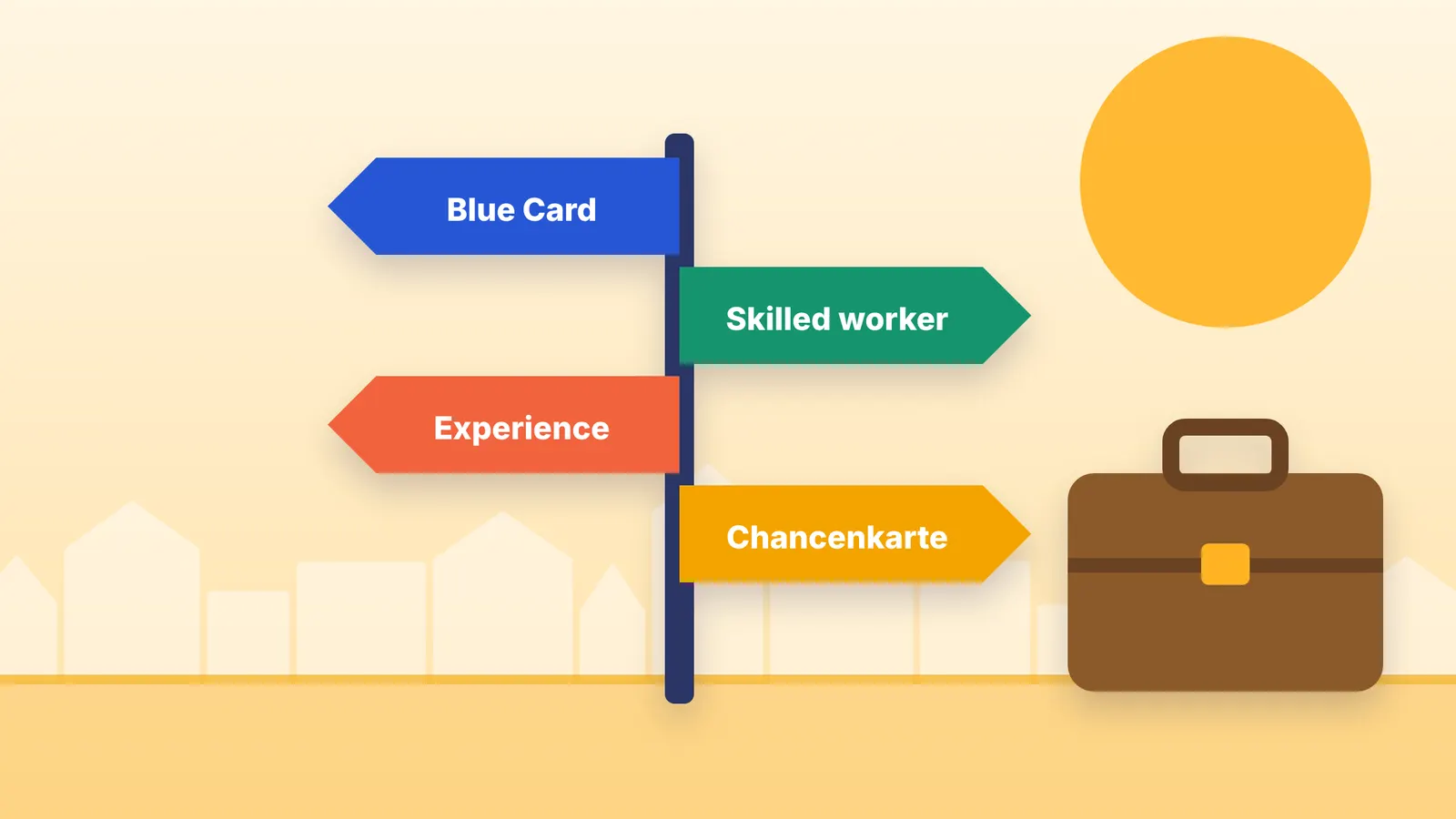
Germany has several work visas, and the right one depends on your degree, your salary and whether you already have a job offer. All salary figures below are gross per year and apply in 2026. They change every January.
Do you need a visa before you come?
It depends on your nationality:
- EU, EEA and Swiss citizens need no visa and no work permit. You only register your address after you move.
- Citizens of Australia, Canada, Israel, Japan, New Zealand, South Korea, the United Kingdom and the USA can enter Germany without a visa and apply for the residence permit at the local immigration office within 90 days. You may not start working until the permit allows it.
- Everyone else applies for a national visa at the German embassy or consulate in their country before travelling.
The routes below apply to everyone from outside the EU; only where you apply differs.
The four routes compared
| Route | You need | Salary in 2026 | Permanent residence |
|---|---|---|---|
| EU Blue Card | Recognised or comparable university degree, job offer | €50,700, or €45,934.20 in shortage jobs and for recent graduates | After 27 months, or 21 with B1 German |
| Skilled worker permit | Qualification recognised in Germany, qualified job offer | No general minimum, but €55,770 if you are over 45 | After 3 years |
| Experience route | 2 years of experience in the last 5, qualification recognised in your home country | €45,630, or pay under a collective agreement | After 3 years |
| Chancenkarte | Points or full recognition, €1,091 a month in savings | None: it is for job searching | Switch to a work permit first |
EU Blue Card
The Blue Card is the strongest option if your salary is high enough. It needs a German or recognised foreign university degree and a job offer at or above the threshold. Your spouse can work without restrictions, and permanent residence comes faster than on any other route.
Skilled worker permit
This permit (§ 18a and § 18b of the Residence Act) needs a qualification that is recognised in Germany and a job that matches it. The Federal Employment Agency usually checks that your pay and conditions match those of German workers. There is no general salary minimum, except the over-45 rule below.
Experience route
Introduced in 2024, this route suits people whose degree is not formally recognised in Germany. You need:
- at least two years of relevant experience in the last five years
- a university degree or at least two years of vocational training, recognised by the country where you got it
- a salary of at least €45,630, or an employer bound by a collective agreement who pays the agreed rate
You do not need to have your qualification recognised in Germany first. IT specialists can qualify through practical experience alone.
The over-45 rule
If you are 45 or older and coming to Germany for the first time, most routes require a salary of at least €55,770, or proof of adequate pension provision.
How to apply
- Check recognition of your degree in the anabin database, or ask the ZAB for a statement of comparability.
- Get a job offer that matches your route.
- Apply for the visa through the Federal Foreign Office's Consular Services Portal and attend your appointment at the German embassy or consulate in your country.
- Ask your employer about the fast-track procedure (beschleunigtes Fachkräfteverfahren), which the employer starts at their local immigration office.
Germany's planned Work-and-Stay Agency has not launched yet. See where it stands.
Common mistakes
- Using last year's threshold. Salary figures change every January, and the rule that applies is the one in force when your permit is decided.
- Forgetting the over-45 rule. It catches senior professionals by surprise.
- Missing health insurance. You need cover that is valid in Germany from your first day. See health insurance in Germany.
- Late Anmeldung. Register your address within 14 days of moving in. See how to do your Anmeldung.
Family and the long term
On a Blue Card or skilled worker permit, your spouse does not need to prove German and may work in any job. See family reunification. For when you can stay for good, see permanent residence and citizenship.
Questions people ask
Which German work visa is fastest to permanent residence?
The EU Blue Card: 27 months, or 21 months with German at B1. Other work permits usually need three years.
Can I get a German work visa without a recognised degree?
Yes, through the experience route, if you have two years of relevant experience, a qualification recognised in your home country and a salary of at least €45,630 (or pay under a collective agreement).
What salary do I need for a German work visa at 45 or older?
At least €55,770 a year in 2026, or proof of adequate pension provision.
Sources
Residence Ordinance § 41 (visa-free entry for certain nationalities): list of countries and the 90-day rule
Make it in Germany: skilled worker residence permit: requirements, over-45 rule, permanent residence after three years
Federal Employment Agency: experienced professionals (April 2026): €45,630 and €55,770
Expatrio: Blue Card vs work permit 2026: Blue Card thresholds and timelines
Information only. Not legal, tax or financial advice. Rules change, so check the official source linked above before you act.
Was this guide helpful?