Your German payslip in 2026: tax, Soli and social security explained
What every line on a German payslip means, the 2026 rates, and why most people no longer pay the Soli.
Short answer
€12,348tax-free basic allowance per person in 2026
A German payslip takes two kinds of deductions from your gross pay: taxes (income tax, plus church tax if you are registered with a church; the Soli applies only to high earners) and social security. In 2026 employees pay roughly 9.3% for pension, 1.3% for unemployment, about 8.75% for health and 1.8% to 2.4% for long-term care insurance. Most employees take home roughly 60% to 70% of their gross pay.
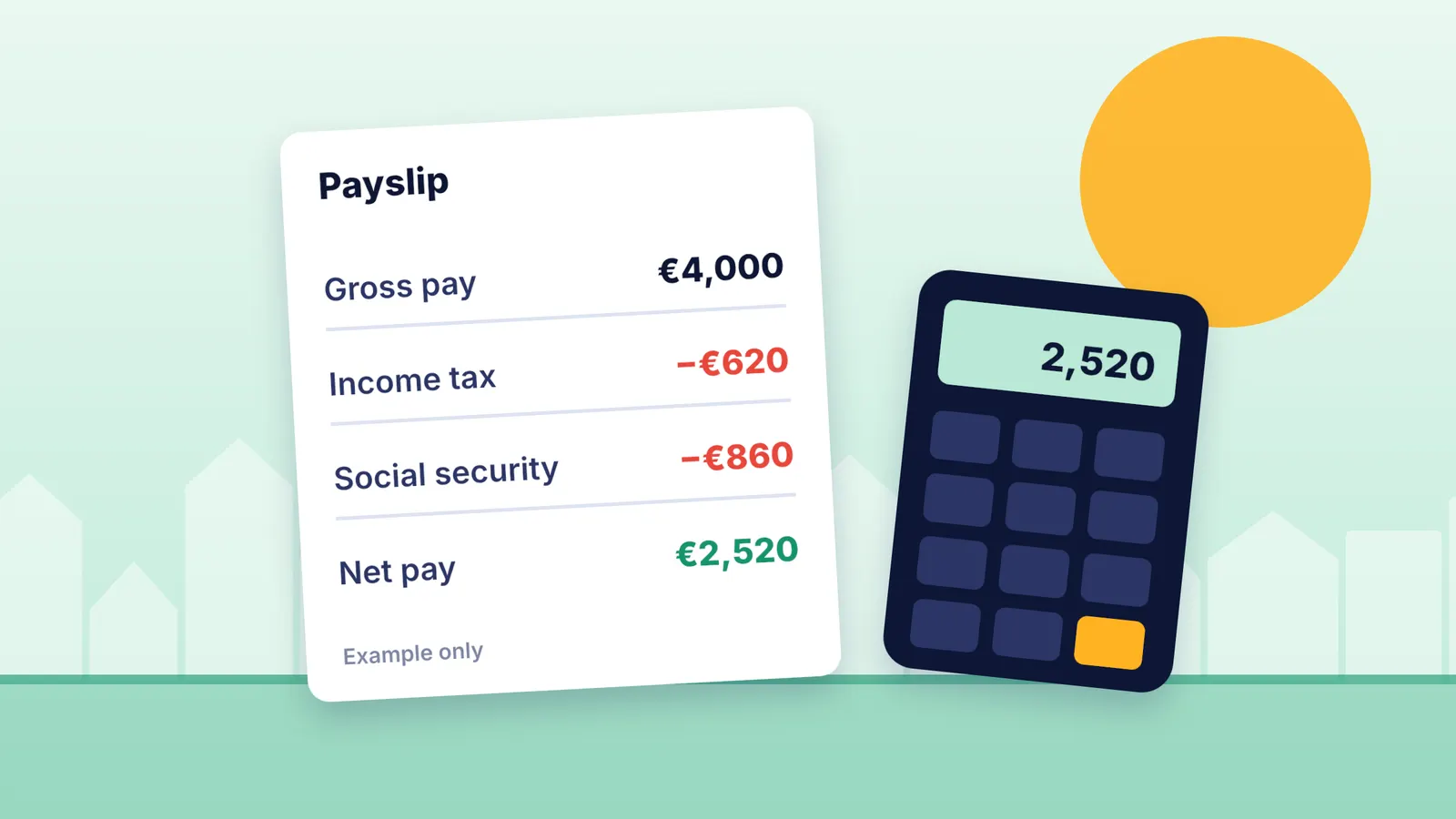
Your first German payslip (Lohnabrechnung or Gehaltsabrechnung) can be a shock: between a third and two-fifths of your gross salary disappears. This guide explains where it goes.
The two blocks: tax and social security
Every payslip starts with your gross pay (Brutto) and subtracts two kinds of deductions to arrive at net pay (Netto).
Taxes
| Line on the payslip | What it is |
|---|---|
| Lohnsteuer | Income tax, based on your tax class and income |
| Solidaritätszuschlag (Soli) | 5.5% of your income tax, but only above a high threshold |
| Kirchensteuer | Church tax: 8% of income tax in Bavaria and Baden-Württemberg, 9% elsewhere, only if you are registered as a member of a church that collects it |
Nobody pays income tax on the first €12,348 of taxable income in 2026 (the Grundfreibetrag).
Social security in 2026
| Insurance | Total rate | Your share as an employee |
|---|---|---|
| Pension (Rentenversicherung) | 18.6% | 9.3% |
| Unemployment (Arbeitslosenversicherung) | 2.6% | 1.3% |
| Health (Krankenversicherung) | 14.6% plus extra contribution (2.9% on average) | 7.3% plus half the extra contribution, about 8.75% |
| Long-term care (Pflegeversicherung) | 3.6% | about 1.8%, plus 0.6% if you are 23+ and have no children |
Health and care contributions stop rising above €69,750 a year. Pension and unemployment contributions stop above €101,400. Above those caps, the share you lose to social security falls.
What happened to the Soli?
The solidarity surcharge was introduced to fund German reunification. Since 2021, about 90% of taxpayers no longer pay it, because it applies only when your income tax exceeds a threshold that rises each year. In 2026 a single person pays no Soli until their income tax reaches about €20,350, which corresponds to a gross salary of roughly €75,000. For married couples filing jointly, the threshold doubles.
If your payslip shows a Soli of zero, that is normal.
Tax classes in one minute
| Class | Who |
|---|---|
| I | Single |
| II | Single parent |
| III and V | Married couples where one earns much more (III for the higher earner) |
| IV | Married couples with similar incomes, optionally with a factor |
| VI | A second job, or when your employer does not yet have your tax data |
Your tax class only changes how much is deducted each month. The final amount is settled in your annual tax return.
Getting money back
Many employees get a refund by filing a tax return. Common deductions are the commuter allowance (38 cents per kilometre from the first kilometre in 2026), work equipment, a home office and moving costs for a job. The flat allowance for work expenses is €1,230, so claim more only if your costs are higher.
Check your own numbers
Use the official calculator of the Federal Ministry of Finance at bmf-steuerrechner.de to estimate your income tax and Soli for 2026.
Questions people ask
Why is my first German salary taxed so high?
Usually because your employer did not yet have your tax ID and had to use tax class VI. Once your tax data is in place, the difference is corrected on later payslips or in your tax return.
Do I have to pay church tax in Germany?
Only if you are registered as a member of a church that collects it, such as the Catholic or Protestant church. The registration form at your Anmeldung asks about religion. Other religions are not charged church tax.
How much of my gross salary will I take home?
For a single employee without children, usually around 60% to 70%, depending on salary, health insurer and church tax.
Sources
Information only. Not legal, tax or financial advice. Rules change, so check the official source linked above before you act.
Was this guide helpful?